1. Introduction
In Part 1, Targeted Defined Contribution (TDC) was introduced from the accumulation phase. The central question was which financial position is required to reach the pension objective, with what probability of success, and within which risk tolerance.
At retirement the economic question changes. It is no longer primarily about building wealth, but about which pension outcome the accumulated financial position can support over the remaining horizon.
The pension objective therefore does not disappear at retirement. It shifts from target wealth to target income. The core logic remains the same:
Accumulation phase: Pension objective → financial position → required return → distribution of outcomes → probability of success.
Decumulation phase: Pension objective → financial position → pension income → distribution of outcomes → distance to the objective.
From wealth to pension income
Accumulated wealth is not the same as pension income. The ultimate pension outcome is determined by the financial position, the remaining horizon and the relevant economic and actuarial assumptions. Return, inflation, mortality and longevity, the conversion of wealth into income, and the applicable benefit and allocation rules all play a role.
TDC does not prescribe these mechanisms. It provides a framework for assessing the resulting pension outcomes against an explicit pension objective. The relevant result is therefore not only expected pension income, but the full distribution of possible pension outcomes and their distance from the objective.
The objective in the decumulation phase
In the illustrative accumulation-phase model in Part 1, a target of 30% of salary in real terms was used for participants who are on target or fewer than ten years behind. The required actuarial return is about 4.36% for a participant on the target path and, under the illustrative assumptions, rises to around 6% at 44 years of missed participation.
Figure 1 shows how the goal-oriented method is applied in the accumulation and decumulation phases. The starting position expresses the distance to the target path in missed participation years (MPY). At Target means the participant is on the target path; a higher number of MPY means a greater distance to the objective.
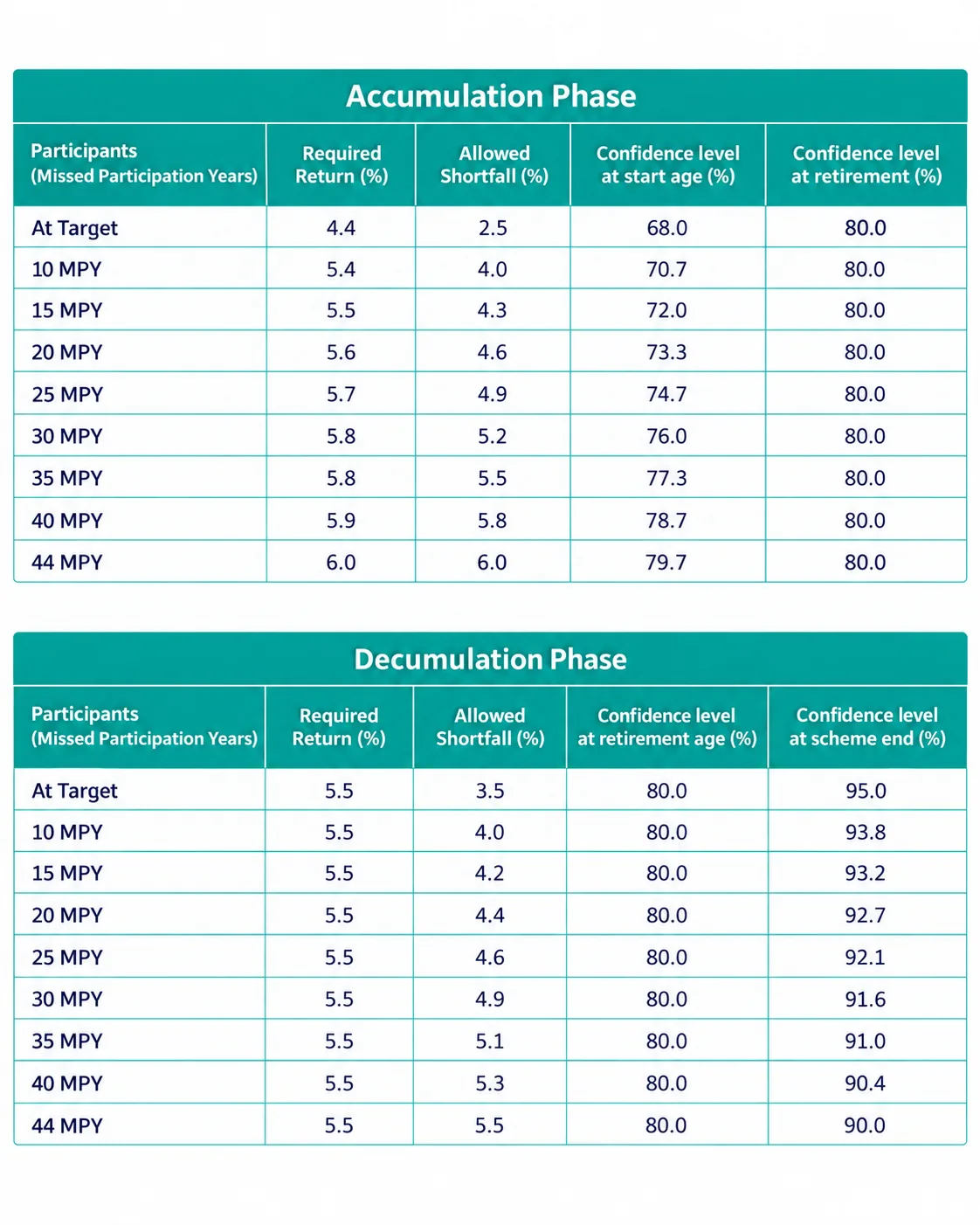
Figure 1 – Relationship between distance to the objective, required return and risk parameters; illustrative parameters for the accumulation and decumulation phases. Not market expectations, statutory requirements or guarantees.
In the decumulation phase the same goal-oriented approach continues. The model includes, among other things, an illustrative required return of 5.5% and a defined band around the objective. These values too are model parameters, not market expectations, statutory requirements or guarantees.
From capital to pension outcome
For every simulated economic scenario, the model determines the path of the wealth relevant to the pension outcome and the pension income that follows from it. The result is not a prediction of a single pension outcome, but a distribution of possible outcomes. The precise way in which wealth is translated into pension income depends on the pension arrangement chosen, the benefit and allocation rules, and the other actuarial and economic assumptions.
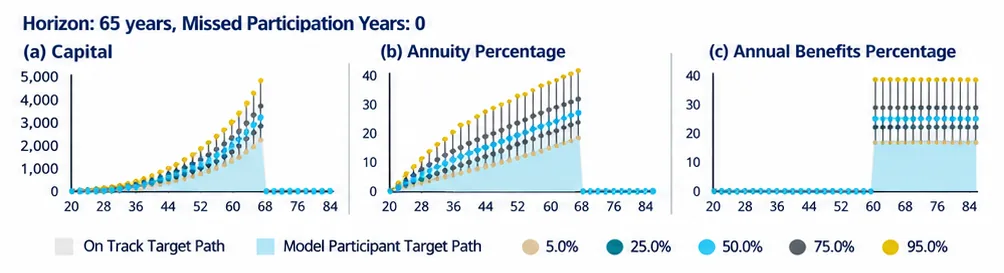
Figure 2 – Distribution of possible pension outcomes. Illustrative model outcomes for an At Target participant with a horizon of 65 years.
Distance to the objective
Part 1 described how participants of the same age can have different financial positions. Years of participation, accumulated wealth, salary progression and other characteristics help determine the distance to the pension objective. That economic distance therefore does not disappear at retirement.
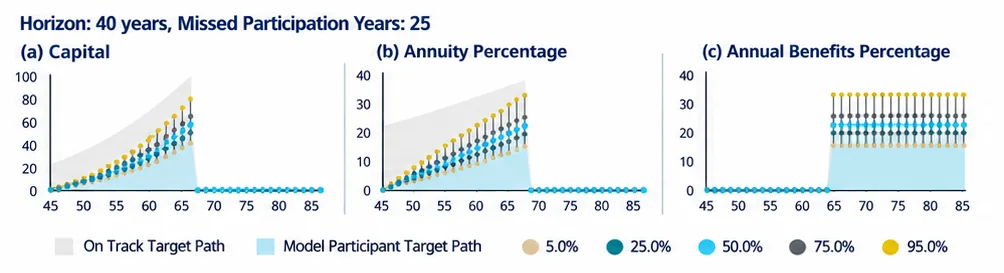
Figure 3 – Pension outcomes at a greater distance from the objective. Illustrative model outcomes for a participant with 25 missed participation years (25 MPY) and a horizon of 40 years.
The relevant insight is that the same goal-oriented method can translate different financial starting positions into different distributions of pension outcomes. After retirement too, it can be monitored how far the financial position is aligned with the pension objective.
Expected pension versus target pension
An expected pension income equal to the objective does not mean that the objective is achieved in every possible outcome. As in the accumulation phase, the assessment should therefore look beyond the expectation to the full distribution of outcomes: dispersion and deviation from the objective, downside risk, and the probability that the outcome remains within the target range.
The assessment thus shifts from expected pension income alone to the extent to which the full distribution of possible pension outcomes aligns with the pension objective.
From objective to investment strategy
The model does not end at the pension outcome. Once the pension objective, the financial position and the distribution of possible outcomes are in view, information also emerges that is relevant to assessing the investment strategy.
In the illustrative model, for example, a decumulation strategy becomes visible in which the composition of investments changes during the payout phase.
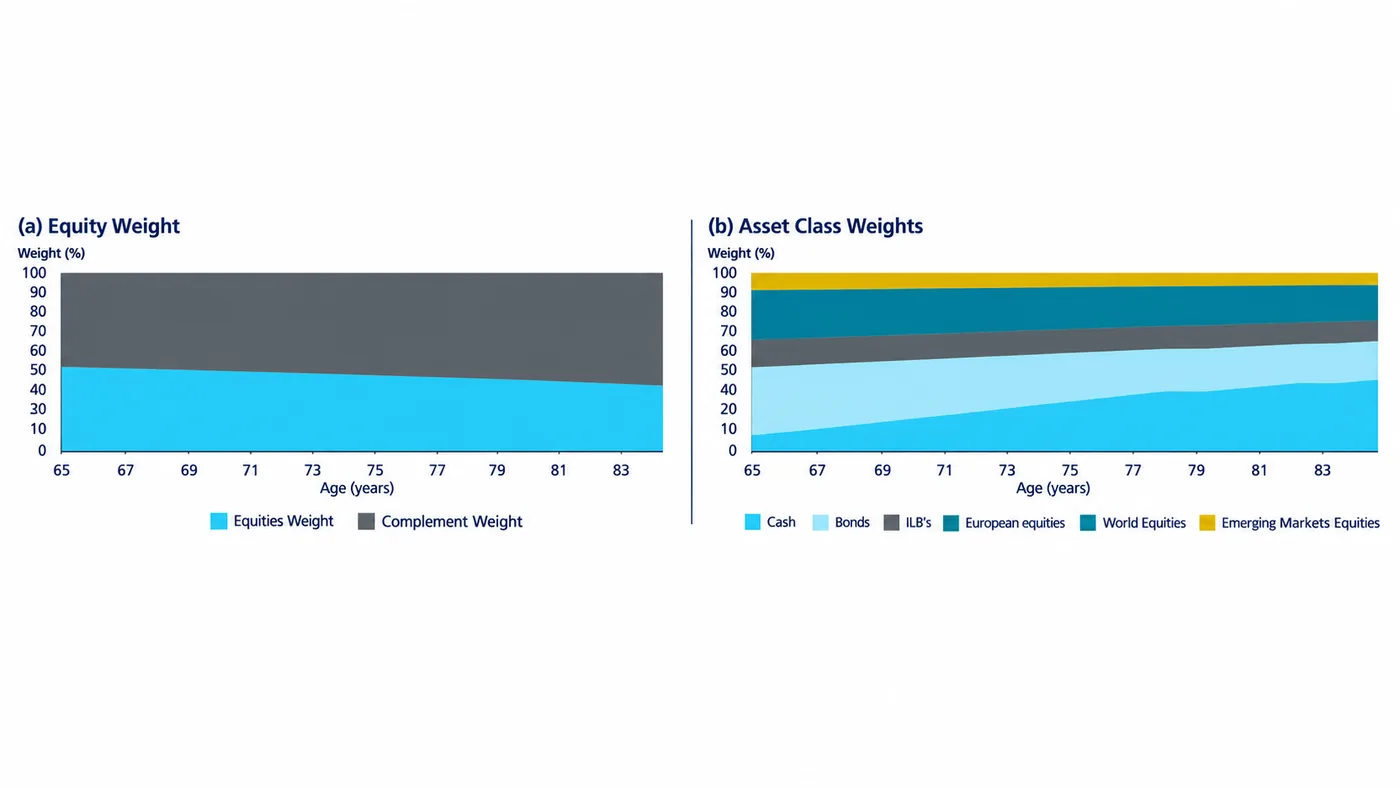
Figure 4 – Illustrative investment strategy in the decumulation phase. Illustrative model outcome for the development of the equity weight and asset-class weights during the decumulation phase.
This investment strategy is not a universal TDC portfolio. The outcome depends on, among other things, the objective, the financial position, economic scenarios, risk tolerance and other model parameters.
The relevant insight is therefore not the specific asset allocation, but the connection:
Pension objective → financial position → distribution of outcomes → assessment of the investment strategy
Within this approach, the investment strategy is not the starting point of the analysis, but a possible outcome of the goal-oriented approach.
TDC within collective DC arrangements
TDC makes the economic position relative to the pension objective visible, without requiring an individually managed investment portfolio. Differences in financial position are analysed and can, where appropriate, then be translated into relevant cohorts or groups. The actual investments and any allocation of return and risk remain part of the existing pension arrangement and its governance.
TDC can therefore be applied within both the solidarity-based pension arrangement and the flexible pension arrangement. It adds a goal-oriented layer of analysis to the existing design: not a different pension contract, but a different way of making the relationship between objective, financial position, risk and investment strategy transparent.
Conclusion
Part 1 centred on accumulation towards the pension objective: the financial position required to reach the objective, the probability of success, and the risk tolerance that fits that aim.
In the decumulation phase the perspective shifts from target wealth to target income. The goal-oriented method remains the same, but the analysis focuses on the pension outcome and the distribution of possible income outcomes relative to the pension objective.
The framework can be summarised as follows:
Accumulation: Pension objective → financial position → required return → probability of success
Decumulation: Pension objective → financial position → pension income → distribution of outcomes → distance to the objective
The pension objective therefore remains the economic reference point throughout the full pension period. Only the way in which the financial position is assessed against that objective shifts: from building target wealth to sustainably supporting target income.
TDC thus provides one goal-oriented method for both the accumulation and the decumulation phase. The method shows how the financial position, the distribution of possible outcomes and the chosen risk tolerance relate to the pension objective. That creates a basis for assessing the investment strategy in the light of the pension objective, without TDC prescribing a specific investment or pension design. Part 3 connects this method to the collective design of the solidarity-based pension arrangement (SPR) and the investment and lifecycle structures of the flexible pension arrangement (FPR).